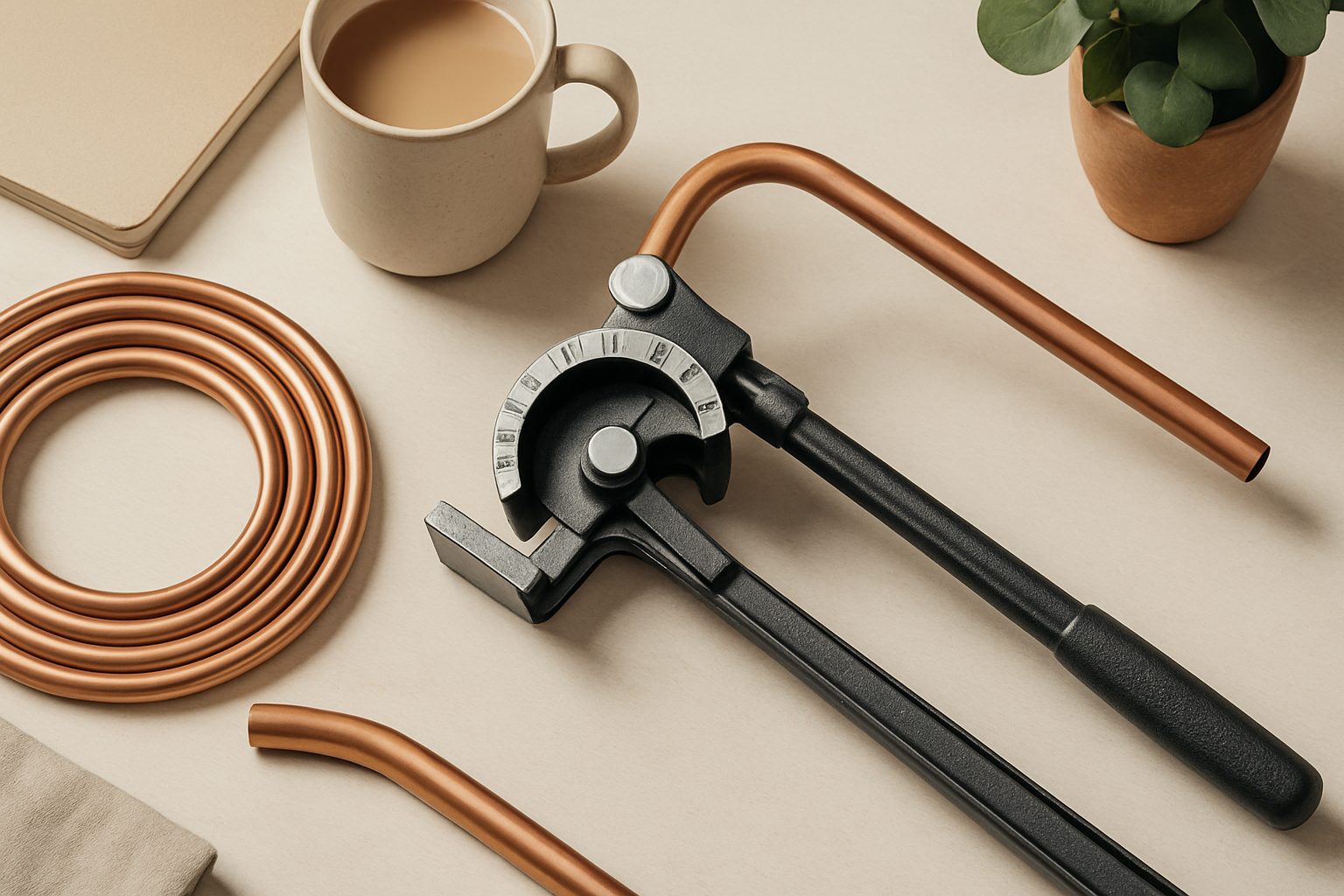
How to Bend Steel Tube in a Home Workshop UK – Tools & Techniques
Bending steel tube for fabrication projects—whether you're building a frame, exhaust system, or rollcage—requires the right technique and tooling. Unlike bending bar stock or sheet metal, tube bending demands precision to avoid kinking, cracking, or distorting the wall thickness. In a home workshop, you've got three realistic methods to choose from, each with different cost and capability trade-offs.
Why Tube Bending Matters in Workshop Fabrication
Steel tube's hollow structure makes it stronger and lighter than solid bar, but this advantage disappears the moment you botch a bend. A kinked or wrinkled tube fails under load. The wall thickness (usually 1.5–2.5mm for workshop projects) crushes inward during bending if the radius is too tight or if inner-wall compression isn't managed. Understanding how each method handles this pressure determines whether your tube stays structurally sound.
Most home fabricators work with mild steel tube (30–50mm diameter, up to 3mm wall) for frames, trailers, or decorative work. The methods below assume this range; larger or thicker material requires industrial equipment beyond home workshop scope.
Mandrel Bending – The Budget-Conscious Approach
A mandrel is a tapered rod inserted inside the tube before bending. It prevents the inner wall from collapsing during the bend, supporting the tube from the inside as external force is applied.
Equipment needed:
- Mandrel set (tapered steel rods in graduated sizes, typically £40–£120 for a home-grade set)
- Bending jig or vice with stops to hold the tube
- Hydraulic press or mallet
- Heat source (optional, makes mild steel more pliable)
How it works: Slide the appropriately sized mandrel into the tube. Clamp the tube horizontally in a vice or bending jig with a shaped former underneath. Apply downward pressure—either with a hydraulic press or hammer strikes—to bend the tube over the former. The mandrel resists inner-wall collapse.
Pros: Cheap startup cost, works for one-off bends, no electricity needed if using a vice.
Cons: Manual effort is tiring for tight bends or multiple tubes. Results depend heavily on operator skill. Getting the right mandrel size matters—too loose and it won't prevent wrinkling, too tight and it jams. Limited to single bends; you can't create compound curves easily.
Realistic for: Occasional hobby projects, single bends in frames, fabricators happy to work slowly.
Roll Bending – The Controlled Middle Ground
A tube roller (or roll bender) uses three cylindrical rollers arranged in a triangle: two fixed lower rollers and one adjustable upper roller. You feed the tube through repeatedly, tightening the upper roller each pass to gradually increase the bend radius.
Equipment needed:
- Tube roller (bench-mounted units start around £200–£400 for light-duty manual types)
- Smooth, flat work surface
- Hand crank or motorised drive (optional)
How it works: The tube sits in the two lower rollers. As you turn the hand crank (or motor spins the rollers), the tube is gripped and fed through. You lower the upper roller incrementally and repeat passes until the desired curve forms.
Pros: Repeatable and consistent. Once set for a given diameter and thickness, you can bend multiple tubes identically. Smooth, predictable curves. Less operator strength needed than mandrel bending. Many manual rollers are affordable for home workshops.
Cons: Slow—you're making repeated passes. Manual models are labour-intensive. Can leave subtle flat spots if the upper roller presses too hard. Limited to gentle curves (large radii); tight bends are difficult or impossible.
Realistic for: Multiple identical bends, production runs (six or more tubes), small-diameter mild steel.
Hydraulic Ram Bending – The Precision Option
A hydraulic tube bender uses a powered ram to push the tube against a curved die in a single, controlled motion. The die diameter determines the bend radius.
Equipment needed:
- Hydraulic tube bender (bench-mounted units, £300–£800; portable models start around £200)
- Hydraulic pump (electric mains-powered for most home models)
- Interchangeable dies for different radii
- Die set for your tube diameter
How it works: The tube is clamped between a stationary die and a moving ram. The hydraulic system applies steady, controllable pressure. The operator watches the gauge to avoid over-bending. Modern units have pressure regulators to prevent crushing thin-walled tubes.
Pros: Precision. Single-stroke bending (no repetitive passes). Consistent results on identical tubes. Capable of tight bends without kinking. Smooth finish, minimal marks on the tube. Fast once set up.
Cons: Higher upfront cost than mandrel or manual roller. Dies are tube-specific; changing diameters means buying new dies (typically £50–£150 per set). Electric-powered models need a mains outlet. Overkill for one-off bends in a hobby workshop.
Realistic for: Regular bending work, professional-grade output, production batches, fabricators who value precision.
Choosing the Right Method for Your Workshop
One or two bends, occasional projects: Mandrel bending in a vice. The upfront cost is negligible.
Repeatable production runs, small diameters (under 35mm): Manual roll bender. The consistency pays off after six or more identical bends.
Frequent work, demanding radii, thicker walls: Hydraulic bender. The precision and speed justify the investment for active fabricators.
Key Workshop Considerations
Heating helps. Mild steel bends more easily at 300–400°C. You don't need to reach cherry-red heat; even a brass-coloured glow softens the material and reduces wall thinning.
Lubrication matters. A light machine oil on the tube and tooling reduces friction and improves surface finish.
Support the exit. As the tube leaves the die or former, support it to prevent springback from bending it back open slightly. This is unavoidable; you'll always bend a touch more than your final target and let it spring back.
Check frequently. Measure your bend radius during work, especially with manual methods. Stopping mid-bend to check is faster than scrapping a bad tube.
Steel tube bending is learnable in a home workshop. Start with the method that matches your project volume and accuracy demands. If you find yourself regularly needing tighter tolerances or handling thicker material, heavy-duty bench-mounted hydraulic benders unlock capabilities that hand tools simply can't match.
More options
- Clarke Pipe Benders (Clarke PB16F & Clarke Strongarm range) (Amazon UK)
- Silverline Pipe Benders & Spring Bender Sets (Amazon UK)
- Monument Pipe Bender & Lever Bender Range (Amazon UK)
- Hydraulic Pipe Bender Kits (12T / 16T multi-former sets) (Amazon UK)
- Rothenberger Rocbend & Copper Pipe Bender Sets (Amazon UK)