How to Bend 15mm Copper Pipe Without Kinking – UK Plumbing Guide
Kinking is one of the most common mistakes when bending 15mm copper pipe by hand. A kinked section weakens the pipe, restricts flow, and often requires cutting out and replacing the entire damaged run. The good news is that with the right technique and tool, you can achieve clean, professional bends every time.
15mm copper pipe is the standard size for domestic heating and cold-water feeds across UK homes. It's stiff enough to resist accidental damage during handling, but thin-walled enough to kink if you apply force incorrectly. Understanding why kinks happen—and how to prevent them—saves time and money on failed attempts.
Why 15mm Copper Pipe Kinks
Copper pipe kinks when the outer wall of the bend gets compressed faster than the inner wall can stretch. The radius of the bend becomes too tight, and the outer surface crumples. This is especially common when:
- Bending by hand with no tool (the pipe simply folds)
- Using the wrong tool for the pipe diameter
- Applying the force too quickly or at the wrong angle
- Attempting bends that are too sharp (less than a 90-degree radius)
Most suppliers recommend a minimum bend radius of 2× the pipe diameter for 15mm copper. That's 30mm from the centre line of the bend—achievable with the right method, but easy to misjudge without one.
The Spring Bender Method
A pipe spring bender is the cheapest and most portable solution. It's a coiled metal sleeve that slides inside the pipe and braces the inner surface while you bend, preventing the outer wall from crumpling.
How to use it:
Insert the spring bender into the pipe from the open end, pushing it through until it sits at the point where you want to bend. Mark the bend centre with a felt pen if you're making multiple bends. Grip the pipe firmly on both sides of the spring—at least 100mm either side—and apply steady pressure to form the bend. Work slowly; rushing forces the spring out of position and defeats the purpose.
Pros:
- Cheap (£5–£15 for a reusable bender)
- Works on all common sizes: 8mm, 10mm, 15mm, 22mm
- Lightweight and easy to carry on jobs
Cons:
- Requires skill to keep the spring centred as you bend
- Spring can stick inside the pipe if the bend is too tight; you may need pliers or heat to remove it
- Manual labour makes consistent, sharp bends difficult for joints that need precise angles
Best for: occasional DIY jobs, tight spaces where powered tools won't fit, plumbers who value portability.
The Lever Bender Approach
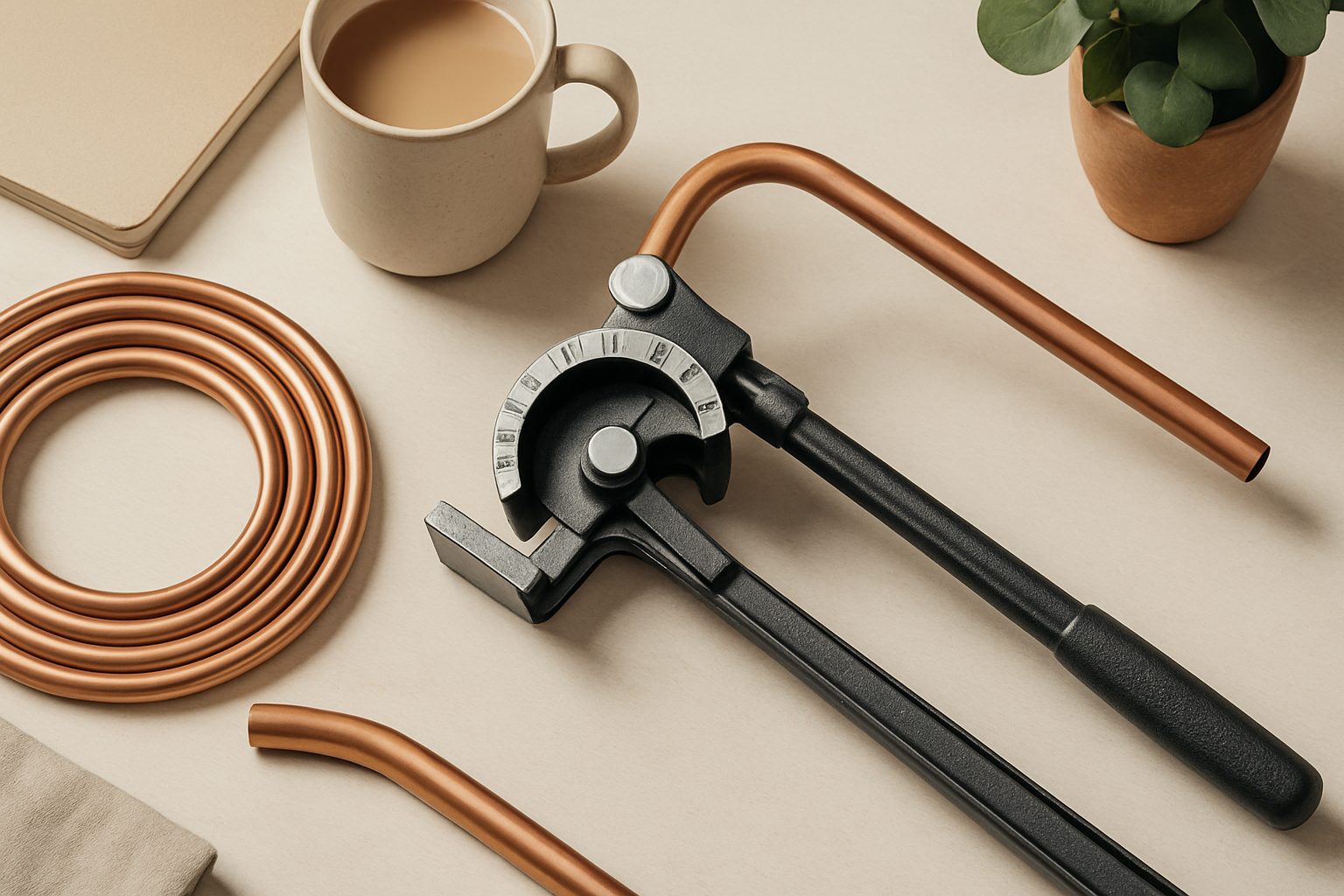
A lever bender (sometimes called a hand bender) uses mechanical advantage to apply force more evenly. The pipe slides into a shaped die, and pulling the lever forces the pipe through a curve. Two common variants exist: fixed-die models and rolling-die models.
Fixed-die benders have a single curved groove that the pipe rests in. You pull the lever handle to push the pipe through. They're straightforward but require good technique to avoid overstretching one side.
Rolling-die benders have a rotating drum that guides the pipe through the bend gradually. As you pull the lever repeatedly, the drum rotates and incrementally bends the pipe. This method gives you more control and is harder to mess up.
Pros:
- Produces repeatable, consistent bends
- Less skill required than spring benders
- Quick once you've set up the tool
- Rolling-die versions are nearly impossible to kink if used correctly
Cons:
- More expensive: £40–£120 for a decent hand bender
- Takes up space in a van or toolbox
- Limited to specific pipe diameters (you'll need a 15mm die fitted)
- Can be slow for large jobs if you're manually pulling the lever
Best for: plumbers doing regular installations, jobs requiring multiple identical bends, work where precision matters (like routing around fixed obstacles).
The Ratchet Bender Method
A ratchet bender (or hydraulic hand bender) uses a pump handle and hydraulic pressure to apply force gradually and evenly. You fit the pipe into the die, align the bend marker, and squeeze the handle repeatedly until the bend is complete.
How it works: Each pump stroke moves the piston a fraction of an inch. This incremental approach gives you excellent control—you can stop mid-bend if you're unsure, and the force is perfectly balanced across the pipe's circumference.
Pros:
- Exceptional control; nearly impossible to kink
- Smooth, professional results
- Works quickly once you're familiar with the tool
- Hydraulic systems distribute force evenly, reducing stress on the pipe
Cons:
- Most expensive option: £80–£250+ depending on brand and capacity
- Requires maintenance (checking fluid levels, occasional bleeding)
- Heavier than lever benders; less practical for one-handed work
- Overkill for occasional DIY work
Best for: professional plumbers, large projects, situations where bends must be precise and damage-free, commercial or critical installations.
Practical Tips for Success
Regardless of which method you choose:
- Anneal the pipe if it's been coiled or kinked before. Heating it gently with a blowtorch and cooling it slowly makes it more ductile and less likely to kink again. You'll see the copper turn black; let it cool naturally rather than dunking it in water (quenching hardens it again).
- Don't exceed a 90-degree bend. For tighter angles, use two gentler bends instead of one sharp one.
- Measure twice. Mark the bend centre clearly on the pipe before you start.
- Practice on scrap pipe first. Even experienced plumbers test their technique before bending a live run.
Which Tool Should You Choose?
For a one-off kitchen or bathroom refit, a spring bender is the sensible choice. For regular work or jobs involving multiple bends in tight spaces, a lever or ratchet bender pays for itself quickly. If precision and durability matter—or if you're bending 22mm or larger pipes—hydraulic tools remove most of the guesswork.
To explore the tools available for your needs, check out our detailed review of the best copper pipe benders for UK homes. We've tested spring, lever, and ratchet models across real plumbing scenarios, so you can see which performs best for your situation.
More options
- Clarke Pipe Benders (Clarke PB16F & Clarke Strongarm range) (Amazon UK)
- Silverline Pipe Benders & Spring Bender Sets (Amazon UK)
- Monument Pipe Bender & Lever Bender Range (Amazon UK)
- Hydraulic Pipe Bender Kits (12T / 16T multi-former sets) (Amazon UK)
- Rothenberger Rocbend & Copper Pipe Bender Sets (Amazon UK)